
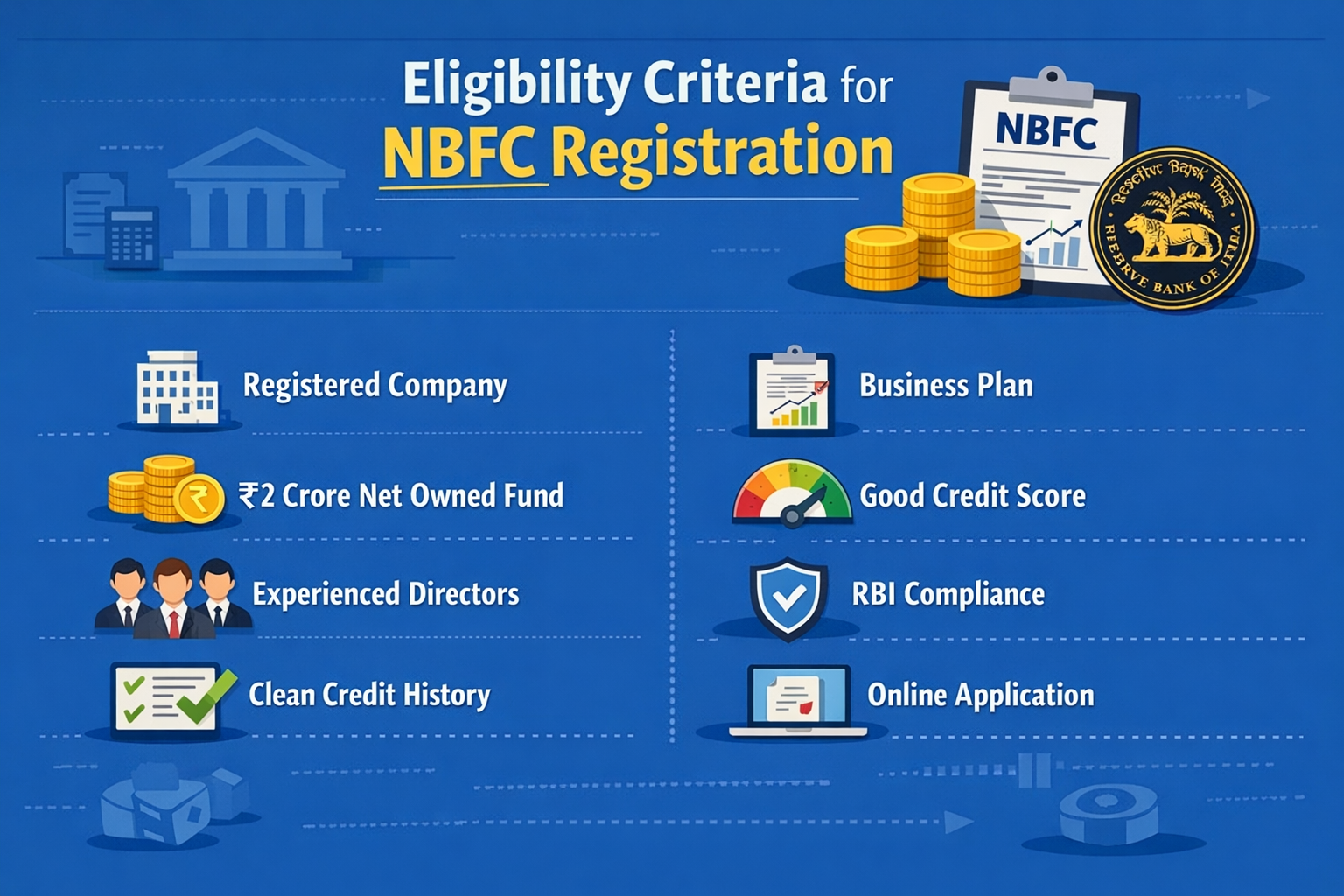
Eligibility Criteria for NBFC Registration
Non-Banking Financial Companies (NBFCs) play a vital role in strengthening the financial system by providing loans, credit facilities, and investment options to individuals and businesses. However, to operate legally in India, a company must meet certain eligibility criteria to obtain NBFC registration from the Reserve Bank of India (RBI).
In this blog, we will explain the key eligibility requirements for NBFC registration in a simple and easy-to-understand manner.
1. Company Registration under the Companies Act
The first requirement is that the applicant must be a company registered under the Companies Act, 2013.
This means individuals, partnerships, or sole proprietors cannot apply for NBFC registration.
2. Minimum Net Owned Fund (NOF)
A company must have a minimum Net Owned Fund (NOF) of ₹2 crore.
- NOF includes paid-up equity capital and free reserves
- It excludes revaluation reserves and intangible assets
This financial requirement ensures that the company has enough capital to operate safely.
3. Qualified and Experienced Directors
The company must have directors with:
- Relevant experience in finance, banking, or management
- Good reputation and clean financial history
The Reserve Bank of India checks the background of directors carefully to ensure credibility.
4. Clean Credit History
Both the company and its directors must have:
- No history of loan defaults
- A good credit score
A strong financial track record increases the chances of approval.
5. Detailed Business Plan
The applicant must submit a proper business plan that includes:
- Nature of financial activities
- Target customers
- Growth strategy
- Risk management policies
This helps the RBI understand how the NBFC will function.
6. Compliance with RBI Guidelines
The company must be ready to follow all rules and regulations set by the Reserve Bank of India, including:
- Fair lending practices
- Anti-money laundering (AML) norms
- Proper documentation and reporting
7. Proper Infrastructure
The company should have:
- A registered office
- Basic infrastructure and staff
- Necessary IT systems
This ensures smooth operations from the beginning.
8. Online Application on RBI Portal
The company must apply through the RBI’s official online portal and submit:
- Required documents
- Financial statements
- Director details
After submission, RBI reviews the application before granting approval.
Conclusion
NBFC registration is a structured process that ensures only financially sound and trustworthy companies enter the financial sector. Meeting the eligibility criteria—such as sufficient capital, experienced management, and compliance readiness—is essential for obtaining approval from the Reserve Bank of India.
If a company fulfills all these requirements, it can successfully apply for NBFC registration and start offering financial services in India.