
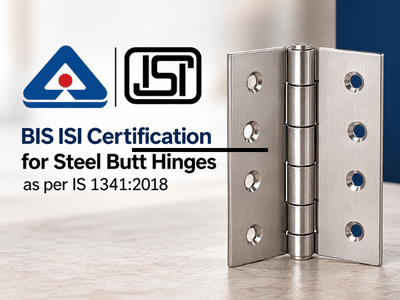
BIS ISI Certification for Steel Butt Hinges as per IS 1341:2018
Introduction
Steel butt hinges are essential hardware components used in residential, commercial, and industrial buildings. They are widely installed in doors, windows, cabinets, and other applications where smooth movement, strength, and durability are required. To ensure consistent product quality and performance, the Bureau of Indian Standards (BIS) has established IS 1341:2018 – Steel Butt Hinges, which specifies requirements for steel butt hinges.
BIS ISI Certification for Steel Butt Hinges helps manufacturers demonstrate that their products conform to the applicable Indian Standard. It also supports compliance with the relevant government quality control requirements for hinges manufactured, imported, or sold in India. <escape>1</escape>
What Is BIS ISI Certification for Steel Butt Hinges?
BIS ISI Certification is a product certification process through which the Bureau of Indian Standards assesses whether a product meets the requirements of the applicable Indian Standard. For steel butt hinges, the relevant specification is IS 1341:2018.
After obtaining the required licence, an eligible manufacturer can use the BIS Standard Mark on the approved products within the scope of the licence. This mark helps buyers identify products certified against the applicable standard.
The certification process generally involves reviewing manufacturing facilities, quality control procedures, testing capabilities, and product conformity.
What Is IS 1341:2018?
IS 1341:2018 is the Indian Standard titled Steel Butt Hinges – Specification. It covers various types and sizes of steel butt hinges and establishes requirements relating to materials, dimensions, construction, workmanship, and finish.
The standard provides a framework for manufacturing hinges that meet specified quality and performance requirements.
Types of Steel Butt Hinges Covered Under IS 1341:2018
The BIS product manual identifies the following categories:
-
Light Weight Steel Butt Hinges (LW)
-
Light Weight Unequal Flap Hinges (LWU)
-
Medium Weight Steel Butt Hinges (MW)
-
Medium Weight Unequal Flap Hinges (MWU)
-
Broad Type Steel Butt Hinges (BR)
-
Square Type Steel Butt Hinges (SQ)
-
Heavy Weight Steel Butt Hinges – Type 1 (HW1)
-
Heavy Weight Steel Butt Hinges – Type 2 (HW2)
The approved product types and sizes must be covered by the applicable licence scope. Manufacturers should consult the latest BIS product manual and the standard before finalising their product range. <escape>1</escape>
Why Is BIS Certification Important for Steel Butt Hinges?
BIS certification plays an important role in maintaining product quality and regulatory compliance in the Indian hardware industry.
1. Compliance with Indian Standards
Certification helps demonstrate conformity with the requirements of IS 1341:2018 and the applicable certification scheme.
2. Consistent Product Quality
Testing and manufacturing controls help verify important product characteristics, including dimensions, construction, material requirements, and finish.
3. Improved Customer Confidence
Builders, contractors, architects, hardware distributors, and end users can use valid certification as an important quality indicator when selecting steel butt hinges.
4. Better Market Acceptance
BIS-certified products may be preferred for construction projects, institutional procurement, and commercial applications where compliance with Indian Standards is specified.
5. Regulatory Compliance
The Government of India has notified quality control requirements covering steel butt hinges under IS 1341:2018. Manufacturers and importers should verify the applicable Quality Control Order, amendments, exemptions, and implementation dates for their particular circumstances. <escape>2</escape>
BIS ISI Certification Process for Steel Butt Hinges
Manufacturers seeking BIS certification should follow the applicable product certification procedure under Scheme I.
Step 1: Review the Applicable Indian Standard
Obtain and review IS 1341:2018, including applicable amendments, to understand the material, design, dimensional, workmanship, and finish requirements.
Step 2: Assess Manufacturing Facilities
The manufacturer should have suitable production machinery, manufacturing infrastructure, process controls, and quality assurance arrangements to produce compliant steel butt hinges.
Step 3: Establish Testing Facilities
The manufacturer must establish appropriate quality control and testing capabilities as required by the standard and BIS certification scheme. Where applicable, testing may be conducted through recognised external laboratories or other permitted arrangements.
Step 4: Prepare the Required Documents
Prepare the applicable technical and business documents, which may include:
-
Manufacturing unit details and address proof
-
Factory layout and manufacturing process flow
-
Machinery and testing equipment details
-
Raw material specifications and supplier details
-
Quality control and inspection procedures
-
Test reports, where applicable
-
Product drawings, types, sizes, and technical specifications
-
Details of the authorised signatory and applicable business registrations
The precise documentation requirements depend on the application route and the current BIS guidelines.
Step 5: Submit the BIS Application
Submit the application through the official BIS online certification portal, along with the prescribed information and applicable fees.
Step 6: Factory Assessment and Product Testing
BIS evaluates the manufacturing and quality control arrangements. Product samples are tested to verify conformity with the applicable Indian Standard. The assessment and testing requirements depend on the certification route and current BIS procedures.
Step 7: Grant of BIS Licence
If the manufacturer satisfies the applicable requirements and BIS approves the application, a licence may be granted for the specified product scope.
Step 8: Use the ISI Mark Correctly
After obtaining the licence, the manufacturer must use the BIS Standard Mark in accordance with the licence conditions and applicable marking requirements. The mark must not be used on products outside the approved scope.
Testing Requirements for Steel Butt Hinges
Product testing is a key part of the BIS certification process. For steel butt hinges, the relevant requirements are specified in IS 1341:2018 and the associated BIS certification documentation.
Depending on the applicable clauses and product type, verification may include:
-
Material conformity and chemical composition
-
Overall hinge dimensions and tolerances
-
Flap thickness and other specified dimensions
-
Hinge pin and knuckle requirements
-
Screw-hole dimensions and positioning
-
Workmanship and construction
-
Surface finish and appearance
The actual test plan must be based on the current standard, the relevant product type and size, and the applicable BIS product manual. Manufacturers should not rely solely on a generic checklist when preparing for testing.
Documents Required for BIS ISI Certification
Preparing the documentation in advance can help manufacturers organise their application and assessment process.
Commonly relevant documents include:
| Document | Purpose |
|---|---|
| Business registration documents | Establish the legal identity of the applicant |
| Factory address proof | Verify the manufacturing location |
| Manufacturing process flow chart | Explain the production process |
| Machinery list | Demonstrate production capability |
| Testing equipment list | Establish quality control and testing capability |
| Product drawings and specifications | Identify the product types and sizes |
| Raw material details | Support conformity with material requirements |
| Quality control records and procedures | Demonstrate consistent manufacturing controls |
| Authorisation documents | Identify the authorised applicant representative |
This list is indicative. The current BIS application requirements should be checked before submission.
Benefits of BIS Certification for Manufacturers
Obtaining BIS certification can offer several benefits to steel butt hinge manufacturers:
-
Demonstrates conformity with the applicable Indian Standard.
-
Strengthens credibility with customers and distributors.
-
Supports participation in tenders and projects requiring valid BIS certification.
-
Encourages systematic manufacturing and quality control.
-
Helps manufacturers address applicable regulatory requirements.
-
Improves transparency regarding the approved product scope.
Certification is not a substitute for ongoing quality assurance. Manufacturers must continue to maintain conformity and meet the conditions of their BIS licence.
Common Challenges During BIS Certification
Manufacturers may encounter difficulties if they have incomplete documentation, inadequate testing arrangements, inconsistent product dimensions, or insufficient quality control records.
Other potential issues include incorrect product classification, differences between tested samples and commercial production, and applying for product types or sizes that are not properly covered by the proposed licence scope.
These challenges can be reduced through a preliminary review of the standard, verification of the manufacturing setup, and preparation of the required technical documentation before applying.
How to Verify a BIS Licence for Steel Butt Hinges
Before purchasing or marketing a product as BIS-certified, buyers and business partners should verify the licence details through official BIS resources.
Check the manufacturer's name, manufacturing address, licence validity, applicable Indian Standard, and approved product scope. Confirm that the product's marking and identification are consistent with the licence conditions.
Official BIS resources include the BIS website and the Know Your Standard portal.
Conclusion
BIS ISI Certification for Steel Butt Hinges as per IS 1341:2018 is an important mechanism for demonstrating product conformity, improving quality assurance, and meeting applicable regulatory requirements in India. Manufacturers should understand the standard, establish suitable production and testing controls, prepare the required documents, and complete the applicable BIS certification process before using the ISI Mark.
For manufacturers, importers, distributors, and construction businesses, understanding the certification requirements helps support informed procurement decisions and more reliable product quality.
Need assistance with BIS ISI Certification for Steel Butt Hinges? Review the latest BIS guidelines and applicable Quality Control Orders, or consult a qualified BIS certification professional to understand the requirements for your specific manufacturing setup and product range.
SEO details for publishing
-
Meta title: BIS ISI Certification for Steel Butt Hinges | IS 1341:2018
-
Meta description: Learn about BIS ISI Certification for Steel Butt Hinges as per IS 1341:2018, including product types, testing requirements, documents, application steps, and compliance.
-
URL slug: bis-isi-certification-steel-butt-hinges-is-1341-2018
-
Primary keyword: BIS ISI Certification for Steel Butt Hinges
-
Secondary keywords: IS 1341:2018 certification, BIS certification for hinges, steel butt hinges ISI mark, BIS licence for steel hinges, steel butt hinge testing requirements, BIS product certification India
Official references
Important: Before publishing, verify the latest amendments and applicable Quality Control Order provisions, since regulatory requirements may change.