
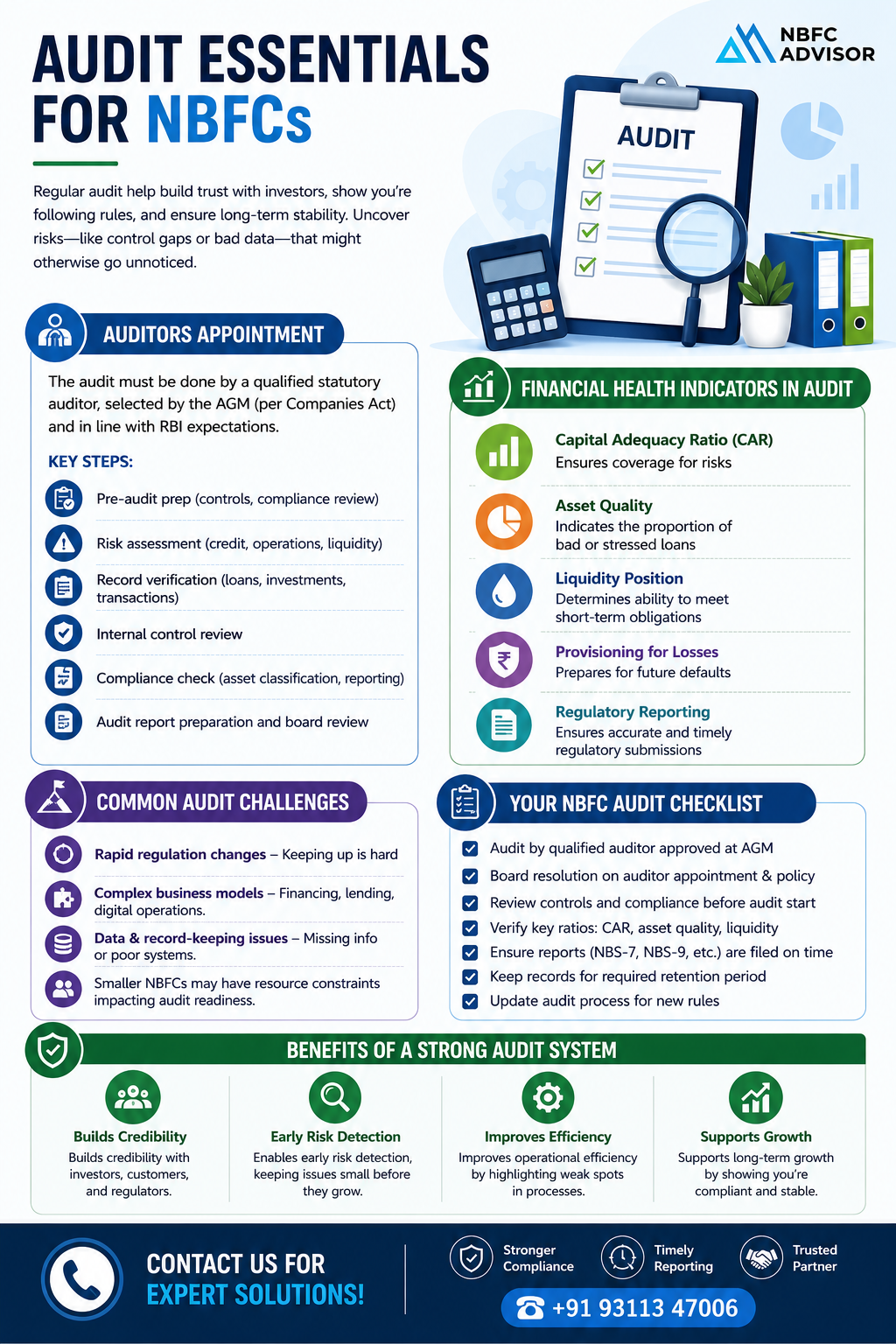
Audits play a crucial role in ensuring that Non-Banking Financial Companies (NBFCs) operate in compliance with regulatory frameworks and maintain financial discipline. Regular audits not only help in identifying risks but also build trust among investors, stakeholders, and regulators like the Reserve Bank of India.
A strong audit system helps NBFCs detect control gaps, improve reporting accuracy, and ensure long-term business stability.
💼 What is NBFC Audit
An NBFC audit is a detailed examination of financial records, compliance status, risk management practices, and internal controls to ensure adherence to RBI guidelines and statutory requirements.
🔍 Auditor Appointment
NBFC audits must be conducted by a qualified statutory auditor appointed as per the Companies Act and RBI guidelines. Proper auditor selection ensures transparency and credibility in financial reporting.
Key Steps in Audit Process
Pre-audit preparation
Review of internal controls and compliance framework
Risk assessment
Evaluation of credit risk, operational risk, and liquidity risk
Record verification
Checking loans, investments, and financial transactions
Internal control review
Identifying gaps in processes and systems
Compliance check
Ensuring adherence to RBI norms and reporting standards
Audit report preparation
Final reporting and review by the board
📊 Financial Health Indicators in Audit
Capital Adequacy Ratio (CAR)
Measures the financial strength and risk coverage capacity
Asset Quality
Indicates the level of non-performing or stressed assets
Liquidity Position
Assesses the ability to meet short-term obligations
Provisioning for Losses
Ensures readiness for future financial risks
Regulatory Reporting
Maintains timely and accurate submission of reports
⚠️ Common Audit Challenges
Rapid regulatory changes
Keeping up with frequent updates in RBI guidelines
Complex business models
Managing lending, financing, and digital operations
Data and record-keeping issues
Incomplete or poorly maintained records
Resource constraints
Limited manpower and systems in smaller NBFCs
🚀 Our NBFC Audit Services
Statutory Audit Support
Complete assistance with statutory audit and compliance
Internal Audit and Risk Review
Identification of risks and improvement in internal systems
Compliance Audit
Ensuring adherence to RBI and legal requirements
Financial Analysis and Reporting
Detailed evaluation of financial performance and ratios
Audit Preparation and Documentation
End-to-end support in audit readiness and documentation
Regulatory Filing Support
Timely submission of reports like NBS returns
📋 NBFC Audit Checklist
Appointment of qualified auditor
Board approval and audit policy setup
Review of compliance and internal controls
Verification of financial ratios
Timely regulatory filings
Proper record maintenance
Updation as per latest regulations
📈 Benefits of a Strong Audit System
Builds credibility with investors and regulators
Helps in early risk detection
Improves operational efficiency
Ensures regulatory compliance
Supports long-term growth and stability
🤝 Conclusion
A well-structured audit system is essential for the smooth functioning and growth of NBFCs. It not only ensures compliance but also strengthens financial discipline and operational efficiency.
With expert audit support and proper planning, NBFCs can minimize risks, improve transparency, and achieve sustainable growth in a highly regulated environment.